

Keep these fields in the source log
- Exact query and language
- Engine, filters and access time
- Original URL, author and publication date


Public research resources · FR / EN
How can a claim and its original source be located ? Practical method, external tools, source log and interpretation limits.
External services · no results hosted here · queries sent only when you click a provider link.


Result counts, ranking and repetition do not measure truth. Several republications may depend on a single source.
Entries draw on the providers’ portals or documentation. Each entry shows its latest review date. Check the provider for current access conditions, pricing and quotas.
All words must match. Word order, accents and case do not matter.
10 entries displayed
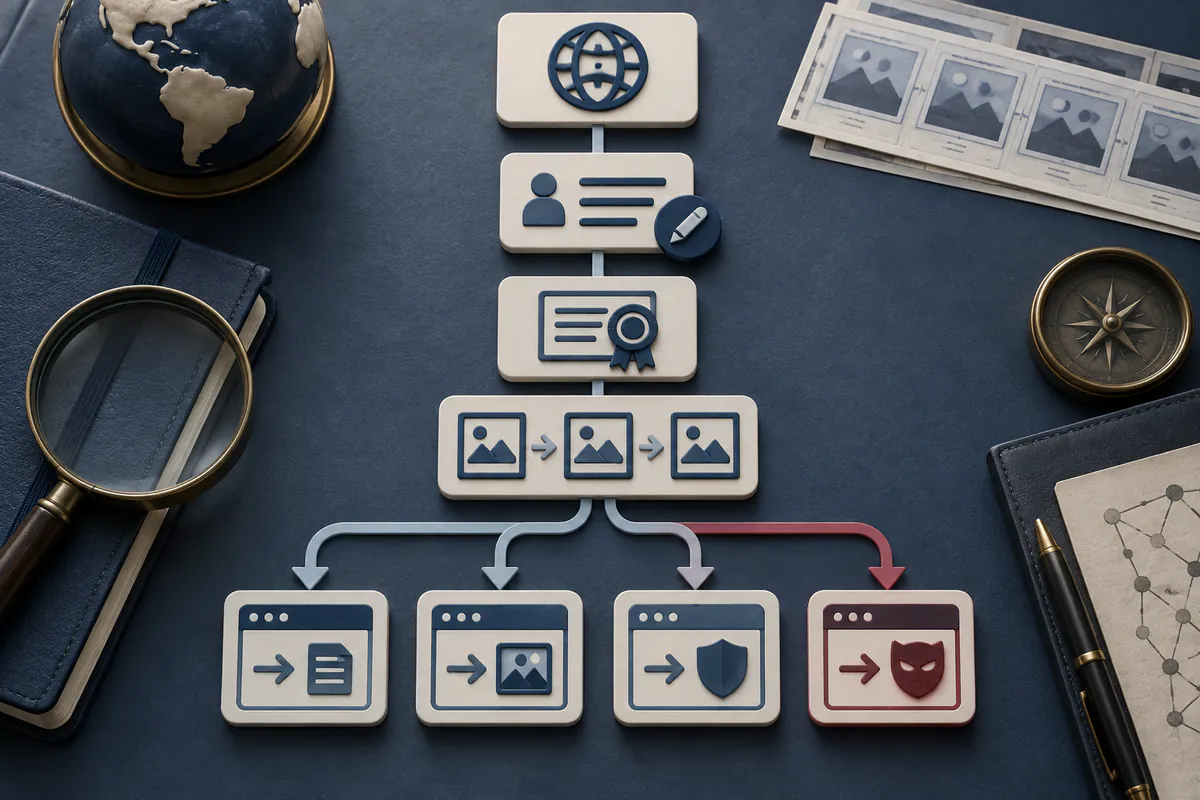
Combine an exact phrase, domain, language and file format to locate a publication.
Record the exact phrase, domain and filters used. Note the title, URL and date on the document’s own page.
Limit: A result snippet may be outdated; open and date the source.
Publisher reference · Record reviewed

Compare another engine’s results and search phrase variants.
Limit: Ranking and indexing do not measure reliability.
Record reviewed

Search public pages, phrases and documents through another entry point.
Limit: Two engines may share sources; their results are not two confirmations.
Record reviewed

Broaden a web search and compare originals with republications.
Limit: Generated answers do not replace the cited documents.
Record reviewed

Search a phrase in an alternative web index and explore less visible sources.
Limit: Coverage varies across languages and websites.
Record reviewed

Locate papers, authors and versions of a research publication.
Limit: A citation or inclusion in the index does not guarantee methodological quality.
Publisher reference · Record reviewed

Find registered-object metadata and its DOI.
Compare title, authors, object type, publisher and DOI; then read the document and any update notices.
Limit: Registered metadata validates neither a study’s methods nor its conclusions.
Publisher reference · Record reviewed

Explore research works and bibliographic relationships.
Retain work identifier, available DOI and applied filters. Check affiliations and authors in original documents.
Limit: An author match or citation count does not constitute independent validation.
Publisher reference · Record reviewed

Find a journal or article in an open-access publication index.
Compare journal title, ISSN, publisher and declared site before trusting a received link. Read the document supporting the claim.
Limit: Journal inclusion does not establish the correctness of a particular claim.
Publisher reference · Record reviewed

Find biomedical-literature citations and abstracts.
Retain PMID, title, publication type and publisher links. Examine correction notices and distinguish abstract from full text.
Limit: A bibliographic record substitutes for neither reading the study nor medical advice.
Publisher reference · Record reviewed
No matching catalogue entry. Try another term or reset the filters.





Read the original record
A site: query is not an exhaustive inventory of indexed pages. Document the scope alongside a negative search result.
| Item | Record to retain | Limit |
|---|---|---|
| Exact query | Expression, operators and domain restriction used. | Different formulations can search different sets. |
| Conditions | Engine, language, filters and consultation date. | Do not treat a displayed result count as corpus size. |
| Retained result | Destination URL and passage actually present on the page. | The search excerpt is not a substitute for the publication. |
Reading exercise · fictional scenario
A search finds twelve pages repeating the same sentence. All cite one article, which does not identify its source.
Before opening the explanation, separate what is observed from what is inferred. Identify the missing check that prevents the broader conclusion.

Twelve websites confirm the fact.

Twelve pages repeat one claim. Its initial source and independent corroboration remain unestablished.

Group reprints by origin, locate the initial passage and seek a document contributing distinct evidence.
This exercise illustrates an interpretation error. It describes no real person, organisation or client case.
On the selected provider’s website, in a new tab. IIS does not retrieve, host or display investigation results. Directory filters only filter the editorial catalogue.
The launchpad builds links inside your browser, without sending the query to IIS or storing it in browser storage. Clicking a prepared link sends the query to the named provider, under its own rules.
No. Access may require an account, subscription, software or quota. The catalogue is available in French and English; providers set their interface languages, coverage and conditions.
No. Index coverage, spelling, language, access limits and capture dates can explain a missing result. Record what was searched and what remains unknown.